
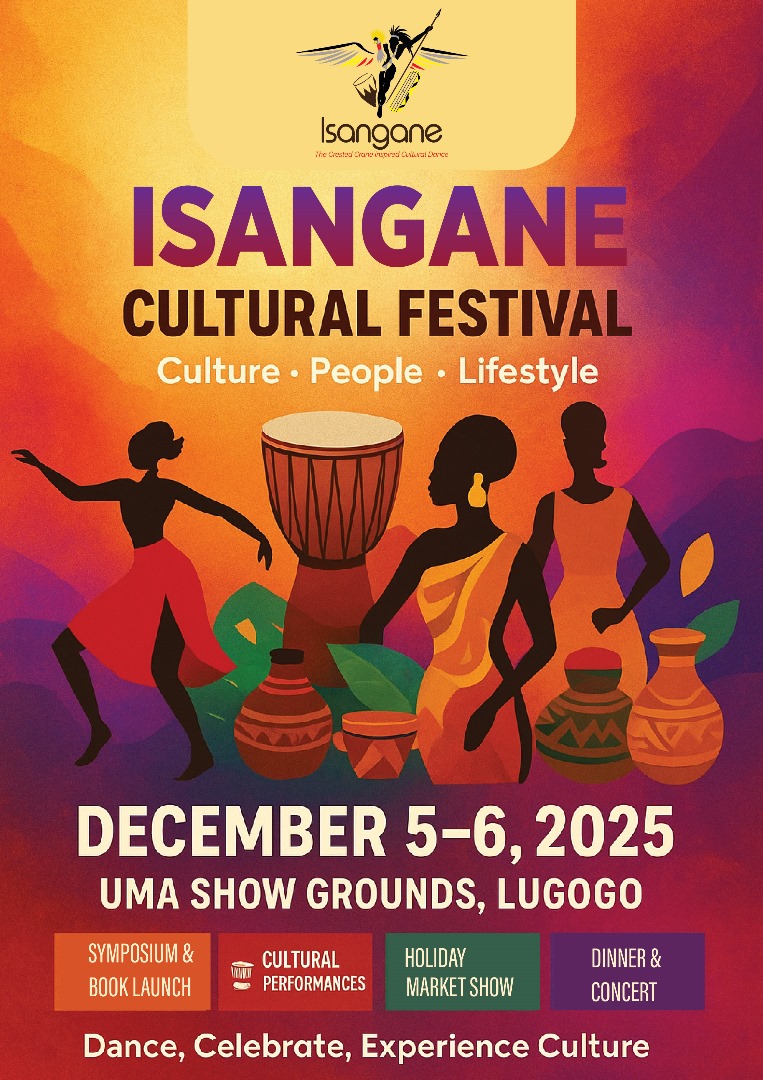
Isangane Cultural Festival 2025
The Isangane Cultural Festival is set to light up Kampala with an unforgettable celebration of culture, people, and lifestyle. Taking place on December 5–6, 2025 at the UMA Show Grounds, Lugogo, this vibrant two-day festival brings together art, tradition, and community in a unique showcase of Bafumbira Culture heritage.
What to Expect
The festival is designed to be a colorful blend of tradition and modern cultural expression. Highlights include:
Symposium & Book Launch – insightful discussions and thought-provoking conversations on cultural identity and heritage.
Cultural Performances – live dance, music, and drama inspired by Uganda’s diverse traditions, with a focus on the Isangane, a dance inspired by the graceful Crested Crane.
Holiday Market Show – a lively marketplace featuring crafts, fashion, food, and authentic cultural products.
Dinner & Concert – an evening experience of fine dining and live performances to close the festival in style.
Theme and Spirit
With its guiding spirit captured in the slogan “Dance, Celebrate, Experience Culture”, the festival is more than just an event—it’s a movement to celebrate unity, diversity, and our identity. Visitors will be immersed in performances, storytelling, and lifestyle experiences that highlight the richness of Bafumbira culture and its connection to the wider African community.
Why Attend?
The Isangane Cultural Festival is perfect for anyone passionate about:
Exploring bafumbira cultural traditions.
Experiencing live performances and authentic music.
Shopping unique handmade products at the holiday market.
Networking with creatives, cultural leaders, and enthusiasts.
Celebrating the joy of community and diversity.
What you may need to know!
Th e Bafumbira are found in the old Districts of Kigezi bordering Rwanda and Congo {DRC). They have however, spread to many parts of Uganda, Ethnical, they are the same as the Banyarwanda of Rwanda. Kisoro is the only District that is inhabited almost exclusively by Banyarwanda. To the west is Congo and their South is Rwanda.
Th e Bafumbira land is mountainous and cool. It was part of Rwanda until the boundary adjustments of 1910. Th e actual inhabitants of Bufumbira, in descending order of numerical superiority, are the Bahutu, Batutsi and Batwa. Essentially, they are Banyarwanda and they speak Kinyarwanda. Th e Batwa are said to have been the original inhabitants of Bufumbira and they are closely related to the Bahutu who are said to have been the second group to arrive in Bufumbira. Then came the Batutsi before A.D 150.The Batwa do not have traditions of early migration from anywhere. They are believed to have been the earliest inhabitants of East Africa together with the Bambuti of Mt. Rwenzori and Ndorobo of Kenya. To date they do not lead a permanent settled life.
The Bahutu are Bantu and like other Bantu,they are believed to have originated from the Congo region of Central Africa around A.D 1000.They are said to have entered Rwanda.
The Origin of Batutsi is however, mythical. One theory says that they originated from Karagwe in Northern Tanzania. Another very controversial one is the “Hamitic myth”
This theory has it that the Batutsi are not indigenous to East Africa, and that their original homeland might have been either Ethiopia or Somalia or Egypt. Th is theory is based, among other things on the fact that the Batutsi tend to resemble the Somali and Galla.